Skip to content

Children’s activity levels rising but inactivity remains too high

More children than ever are taking part, but too many are missing out on the benefits of an active lifestyle.

4th December 2025

The number of children and young people playing sport and taking part in physical activity in England is at the highest level since we started our Active Lives Survey in 2017-18. 

Our latest Active Lives Children and Young People Survey Report, which we’ve published today, shows that there are more than half a million (580,000) more children meeting the Chief Medical Officers’ (CMO) guidelines of taking part in an average of 60 minutes or more of sport and physical activity every day than there were seven years ago – an increase of 5.8%. 

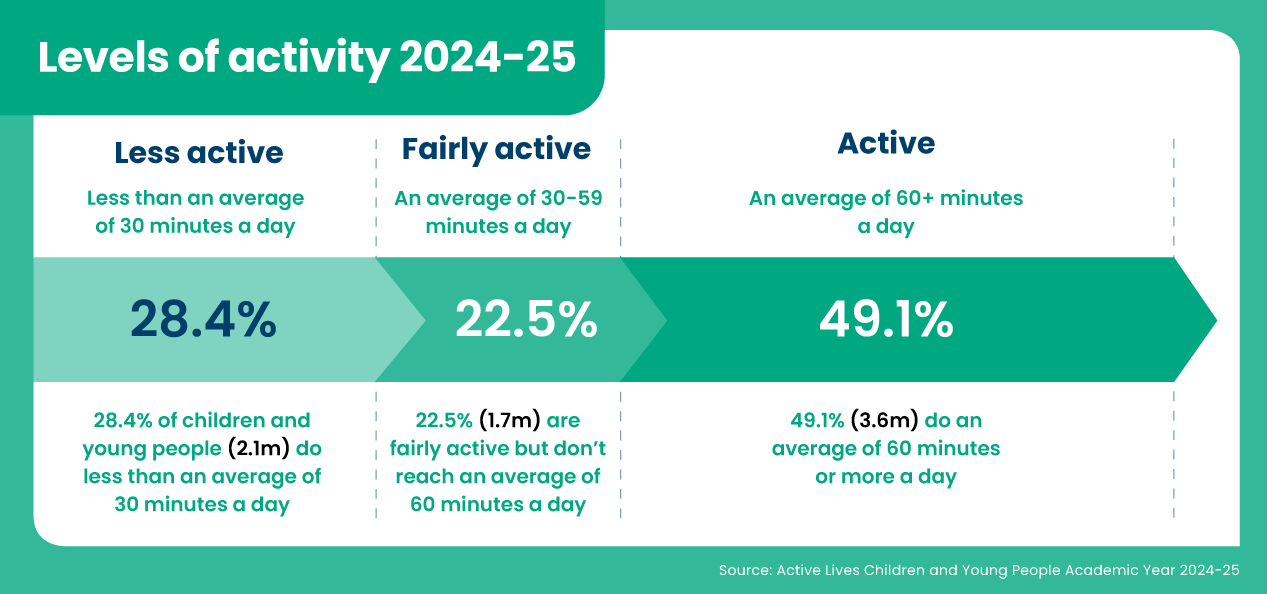
Graphic showing overall activity levels for children and young people from the 2024-25 Active Lives Survey report. It shows 28.4% (2.1 million) are 'less active' - doing less than an average of 30 minutes of physical activity a day. 22.5% (1.7m) are fairly active - doing an average of 30-59 of physical activity a day. 49.1% (3.6m) are active - meeting the Chief Medical Officers' guideline of an average of 60+ minutes of physical activity a day.

This reflects significant progress, especially considering the huge disruption caused by the Covid-19 pandemic, and is testament to the hard work of schools, sports clubs and many organisations across the sport and physical activity sector.   

However, today’s report also shows that less than half of all children (49.1%) meet the CMO’s guidelines and that significant inequalities remain – underscoring how much there is still to be done to ensure every child in England enjoys the physical and mental health benefits of taking part. 

Active Lives explained

Inequalities

Today’s findings reinforce that participation in sport and physical activity varies greatly among different demographic groups.   

Significant inequalities remain in activity levels, with Black (41%) and Asian (43%) children and young people, and those from the least affluent families (45%), still less likely to play sport or be physically active than the average across all ethnicities and affluence groups.  

Girls (46%) are also less likely to be active than boys (52%), and the gender gap is widest between boys and girls from Asian (11.2%), Black (10.6%) and other (12.5%) ethnic groups. 

With White British (51%) and White Other (53%) children’s activity levels increasing at a faster rate, the gap by ethnic group has widened over the past 12 months.  

Children and young people from the least affluent families are the least likely to be active, with only 45% meeting the CMO guidelines, compared to 58% of those from the most affluent families.  

Whilst those from the most and mid-affluence families have seen increases over the last two years, those from the least affluent families have not, indicating inequalities have widened in the short term.  

Download the full report to explore in detail levels of activity for different demographic groups and how children’s relationship with sport and physical activity changes as they get older.  

Download the report

Click on the link below to read our report – if embedded links in the PDF do not function correctly in Google Chrome, please use another browser, or open the report in a dedicated PDF viewer:

Chief executive's reaction

“Today’s findings are encouraging. Children’s activity levels are now the highest since the Active Lives Survey began, reflecting the positive impact that schools, clubs, community organisations, and many others are having across the country. 
 
“More than half a million additional children are now meeting the Chief Medical Officers’ guidelines. That is real progress and something the sport and physical activity sector can be proud of, especially after the huge disruption of the pandemic. 
 
“But the report also makes clear how much more we must do. It cannot be right that fewer than half of children are moving as much as recommended, and that stark inequalities mean too many amongst the poorest in our society miss out. We need a renewed national effort to change this.  
 
“At Sport England we remain committed to working with all our partners to ensure that every child in England can enjoy the physical, social and mental benefits of an active life, wherever they live and whatever their background.” 

Simon Hayes

Chief executive, Sport England

What else is in the report?

Today’s latest Active Lives Children and Young People Survey Report also explores some of the outcomes of being physically active and why being active is so beneficial to the child.  

There’s a positive association between levels of engagement in sport and physical activity and levels of mental wellbeing.  

Mental wellbeing scores (based on a happiness scale of 1-10) are higher for those who are active (7.1) than those who are fairly active (6.9), which in turn are higher than for those who are less active (6.7).  

Active children and young people (38%) are also more likely to strongly agree with the statement ‘if I find something difficult, I keep trying until I can do it’ than those who are fairly (31%) or less active (29%).  

Active children and young people (26%) are more likely to strongly agree they can trust people of a similar age to themselves, than those who are fairly (24%) or less active (23%). 

  • Physical literacy

    The report also does a deep dive into physical literacy and children’s attitudes towards sport and physical activity.  

    Children and young people with no positive attitudes are less likely to be active than those with one positive attitude. Those with three or four positive attitudes are the most likely to be active. 

    It shows there are significant differences between boys' and girls’ attitudes over time. 

    Read less about Physical literacy
  • Place

    The report’s publicly available data tables also underline the importance of place, as activity levels vary significantly across the country.  

    Children and young people who go to school in Sport England’s Place Partnership areas are as equally likely to be active as those who go to school in other places.  

    This is significant because our Place Partnerships were selected as they had the highest levels of inactivity and social need.  

    Read less about Place
  • Types of activities

    Our report also outlines the types of activity being undertaken by children and young people, and how this changes as they get older. 

    Active play (64%), active travel (61%) and playing team sports (58%) are the most common activities across all children and young people. 

    Team sports are less common among infant-age children (41% taking part in school Years 1-2, ages 5-7) but gain in relative importance with age (58% taking part in school Years 7-11, ages 11-16).  

    Conversely, going for a walk, dancing and swimming are all more common for younger children but become less significant as they get older.  

    Read less about Types of activities
  • Active Travel

    The proportion of children and young people walking, cycling or scootering to get to places (active travel) has increased compared to 12 months ago, suggesting a small upward trend post-pandemic. 

    There are now 13.7%, or 1.2 million, more children and young people travelling by active means than seven years ago (academic year 2017-18). 

    Read less about Active Travel
  • Volunteering

    2.3 million (48%) children and young people volunteered to support sport and physical activity in the last 12 months. 

    Despite a small increase compared to 12 months ago, volunteering rates appear to have settled at a lower level than pre-pandemic.

    There are 5.6%, or 18,000, fewer children and young people volunteering compared to seven years ago (academic year 2017-18).  

    Volunteering rates are similar between boys and girls, but ethnicity and family affluence significantly impact how likely a child is to volunteer.   

    Read less about Volunteering

Our work to help more children and young people become active

Children and young people are central to our long-term strategy, Uniting the Movement, and runs through our partnerships, place-based investment, the Movement Fund and our campaigns.

We believe every child has the right to be active and heard, and their voices should help shape the experiences they have in school and in their communities.

Positive, meaningful experiences with sport and physical activity lay the foundations for an active life. 

  • Targeted investment and focused work

    Since March 2022, we’ve invested more than £600 million in over 130 long-term partnerships, recognising the vital role partners play in creating positive experiences for young people, whether as participants, leaders, coaches or volunteers. Partners include national governing bodies of sport, the Youth Sport Trust, UK Youth, Active Partnerships and StreetGames. 

    Our £250m of National Lottery and Exchequer funding for place-based work continues to support the communities and young people who need it most. Building on learning from our local delivery pilots, this investment is targeted and driven by sustained community engagement, ensuring children and young people shape interventions that are accessible, enjoyable and rooted in local needs. Examples of this work include:   

    • In Blackpool, a youth leadership programme, co-designed with 16-25-year-olds, has ensured young people’s voices shape decisions. Engagement with over 500 girls and young women in the town revealed barriers to activity including body image concerns, safety worries and limited school activity options. This insight is now reshaping how local schools and community groups design activity for teenage girls.    
    • In Bradford, JU:MP - a flagship programme working in deprived communities to get children aged 5-14 and their families physically active.  
    • In Greater Manchester, GM Moving is helping children and young people across the city region to build more activity into their daily lives.   

    To tackle inactivity and help families keep children moving all year-round, we’ve also supported the Government’s new ‘Let’s Move!’ campaign. The campaign aims to help parents discover simple, fun, and pressure-free ways to build movement into daily life. This campaign is launching in many of our local Place Partnerships including areas such as Sandwell, Lancashire, Essex and Bradford. 

    Since the launch of the Physical Literacy Consensus Statement for England, 289 partners and organisations have joined the Positive Experience Collective to explore how to embed physical literacy in policy and practice. With these partners, we’ve developed the THRIVE principles to help practitioners apply a child-first approach, recognising that every young person’s relationship with activity is personal and changes over time. 

    Play Their Way, our £4m coaching campaign, now has 10,000 members committed to child-first, enjoyment-led coaching. The campaign brings together 16 partner organisations and aims to support England’s 2.6 million coaches to build a grassroots movement for child-first coaching. 

    We’ve also invested £2.6m into Studio You, a ‘Netflix’-style digital platform helping PE teachers engage the least active girls through non-traditional sessions such as dance, strength training and mental fitness. Launched in 2021, the platform is free to all secondary schools; 68% of schools in England have now signed up, reaching an estimated 722,000 teenage girls. The 2024-25 Studio You evaluation found that 97% of girls felt the new content helped them feel more included in PE while 91% said Studio You motivated them to be more active outside lessons. 

    Read less about Targeted investment and focused work

How does this report compare to our findings on adults' activity levels?

Today’s report complements the Active Lives Adult Survey we published in April.    

That report, which focussed on activity levels between November 2023 and November 2024, showed the number of people playing sport and taking part in physical activity in England is at the highest level on record. 

Active Lives Adult Survey

Further reaction

Active Travel Commissioner and Sport England Chair, Chris Boardman

“It’s fantastic to see more children walking, cycling and scooting to the places they need to go. Active travel isn’t just a way of getting around. It’s the foundation for healthier, more confident and more independent young people.

“The fact that 1.2 million more children are travelling actively than seven years ago shows a real cultural shift beginning to take hold. After the disruption of the pandemic, this upward trend is especially encouraging.

“But this is also a reminder of what’s possible when we create streets, routes and communities where safe, everyday movement is the easy choice. If we create people-friendly places and giving families real alternatives to the car, we can help an entire generation build active habits that last a lifetime.”

Sports Minister, Stephanie Peacock MP

"Every time a child kicks a ball, swims a length, or runs around with friends, they are supporting their health and wellbeing.

"Today's growth in activity levels is positive, and a real credit to the hard work of teachers, coaches, volunteers and parents who inspire young people to get moving every single day.

"But we know there is more to do. Too many children still miss out on the joy and benefits of sport.

"That is why we are investing £400 million in grassroots sports facilities where they are needed most, and launching a new PE and School Sport Partnerships model to ensure that every child, no matter where they live or whatever their background, gets the same opportunities to be active."

What's next?

Our next Active Lives Adult Survey report will be published on Thursday 23 April 2026.  

It’ll cover the period from November 2024 to November 2025 and will give a detailed breakdown of overall activity levels, types of activities undertaken and demographic variations in England during this period.

The next Active Lives Children and Young People Survey report will be published on December 3 2026, covering the academic year 2025-26.
 

Additional information

Our Active Lives Children and Young People Survey, conducted by Ipsos, gives the most comprehensive overview of the sport and physical activity habits of children in England.      

It looks at the number of children taking part in a wide range of sport and physical activities (ranging from dance and scootering to active play and team sports) at moderate intensity.     

The report’s based on responses from, and on behalf of, more than 100,000 children aged 5-16 in England during the academic year 2024/2025, making it one of the largest studies of its kind in the world. 

Sign up to our newsletter

You can find out exactly how we'll look after your personal data, but rest assured we'll only use it to make sure you receive our newsletter, to understand how you interact with our newsletter, and to provide administrative information about our newsletter.