

Sorry, you need to enable JavaScript to visit this website.
Skip to content

From insight to innovation

As TASS announce their class of prospects, our head of England talent development pathways blogs on what young athletes told us and how TASS and Explorers Club are turning that insight into ideas athletes can see and carry.

15th October 2026

by Hannibal Morris
Head of England talent development pathways, Sport England

In April 2023, Arne Güllich, Michael Barth, Brooke Macnamara and Zach Hambrick published a systematic review that leaves anyone designing athlete development pathways scratching their heads.

They pooled data on more than 38,000 juniors and almost 23,000 seniors across a wide range of sports.

Their conclusion was that successful juniors and successful seniors are largely two different groups of people.

For example, 89.2% of international-level juniors at U17/18 didn't go on to compete internationally as seniors.

And 82% of international-level seniors hadn't competed internationally at U17/18.

So, what can we take from this?

First, we must keep supporting the sports we work with to design pathways that are aware of this paradox.

That means building in features that let athletes on the edges of a pathway keep exploring their potential for as long as they want to.

Second, we must keep generating insight about our audience, young people with sporting potential, so we can keep improving the environments and experiences we create for them.

Starting with insight

That's why, in 2025, we worked with the Youth Sport Trust and insight and strategy company Beyond to create a playbook called Wired to Win.

It's a seminal, multi-sport study that explores the minds and motivations of Britain's next generation of sporting talent.

Two of its insights stood out.

For aspiring athletes, in a world full of ambiguity, winning stands alone as an undeniable truth.

It's a rare moment of absolute certainty: no debates, no nuance, just clear proof that they're on the right path.
 

We must keep generating insight about our audience, young people with sporting potential, so we can keep improving the environments and experiences we create for them.

Every sacrifice makes sense and, in team sports especially, the shared celebration creates a feeling of belonging that makes the journey worthwhile.

But winning as fuel can become the weight of performance when it's tied too closely to self-worth.

We also learned that young athletes' motivation increasingly runs on a visible link between effort and reward, or in their words, "the pay-off cycle".

When that link breaks, so does everything downstream.

Answering the call

But how do you go from insight to innovation?

In 2022, I wrote a blog with this call to action: "Building the future of sport will take all of us – creators, builders, futurists, disruptors, makers, doers."

TASS answered that call.

TASS is a decentralised performance services institute, built as a partnership between Sport England, national governing bodies (NGBs), a UK-wide network of delivery sites and the practitioners who work in them.

It sits at an unusual intersection, with youth culture on one side and high-performance sport on the other.

This year's intake will take the number of athletes TASS has supported past 10,000, across 73 sports and disciplines.

At Paris 2024, 123 current and former TASS athletes competed and won 60 medals between them.

Together, Sport England and TASS recently partnered with strategy and design studio Explorers Club and put two questions to them.

How can we create a sense of belonging that doesn't rely on winning alone?

And how can we make progress more visible?

Two interconnected ideas emerged.

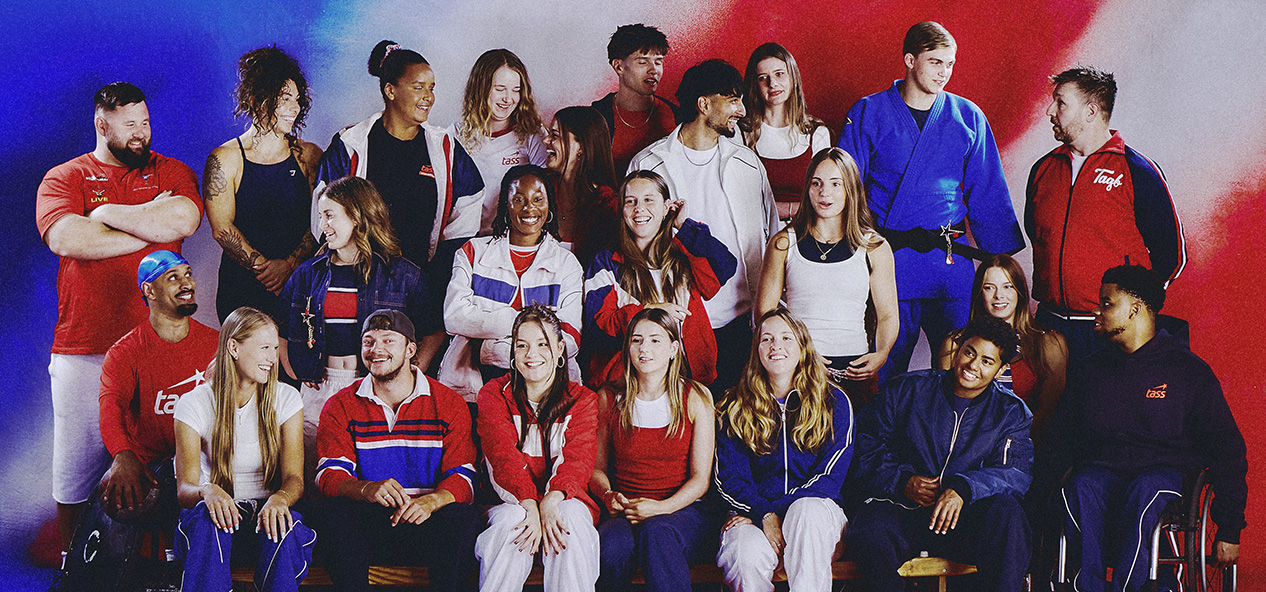
The Class of TASS treats induction as a moment worth marking, bringing athletes together, photographing them as a cohort and showing them who else is in this with them.

Group image of the Class of Tass athletes. All wearing a variation of red, white and blue, stood against a red, white and blue backdrop.

The carabiner and accolade system is a physical answer to the visibility problem.

Each athlete gets a carabiner in the shape of the TASS star, then unlocks accolades for different kinds of progress, from engaging consistently with TASS services to representing their country.

Progress you can see, and carry.

Close up of a star-shaped carabiner, hanging from an athletes waistband, with a Great Britain pendant hanging from it.

Coming full circle

A special thank you to Explorers Club, a truly unique studio that has helped us turn insight into creative ideas with the potential to take athlete support somewhere new.

And thank you to Beyond, who continue to support our insight work.

We're now working with them on the next phase of Wired to Win, learning more about young people with sporting potential who are further away from traditional talent pathways.

Because, as I said at the start, the top juniors don't always become the top seniors.

More to come on this soon.
 

Find out more

Meet the Class of Tass

Sign up to our newsletter

You can find out exactly how we'll look after your personal data, but rest assured we'll only use it to make sure you receive our newsletter, to understand how you interact with our newsletter, and to provide administrative information about our newsletter.